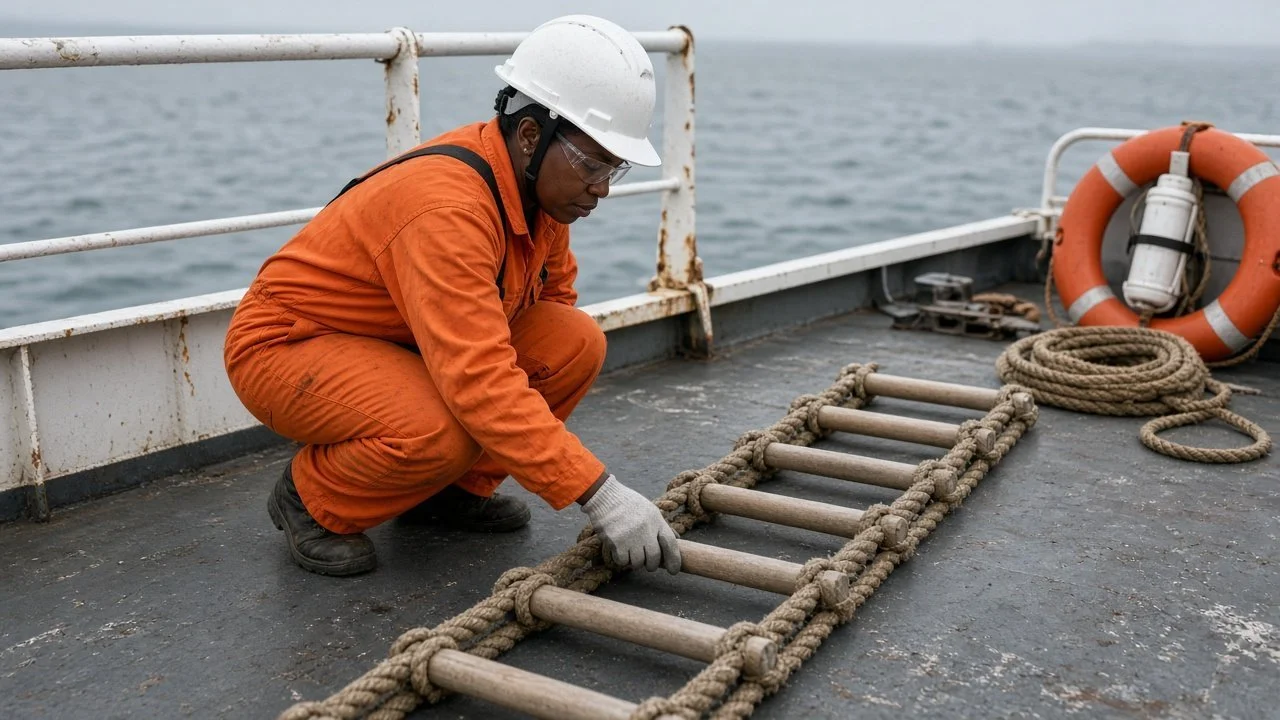


Pilot ladder safety is one of the few parts of a port call where a small rigging mistake can cost a life within seconds. A pilot climbing from a moving boat to a ship's side, often at night or in a swell, depends entirely on equipment that the ship has chosen, maintained and rigged. Pilots' organisations have raised the issue for years, and the subject keeps returning to safety bulletins for the simple reason that defective or badly rigged ladders are still found. This article is a plain-English briefing for masters, officers and crew. It is not legal advice, not a statement of any flag's requirements, and not a substitute for the current official texts.
The photographs are illustrations of a pilot transfer and a deck check. They should not be read as evidence that the equipment shown meets any particular standard.
Where pilot ladder safety rules come from
The starting point is SOLAS Chapter V, Regulation 23, which covers pilot transfer arrangements. It is supported by IMO guidance on pilot transfer arrangements, and by the international standard for pilot ladder construction, ISO 799. Flag administrations and port authorities may add their own requirements, and the ship's safety management system should set out how the ship meets them.
IMO has also adopted amendments to Regulation 23 and new performance standards for pilot transfer arrangements. When a rule change of this kind is adopted, the dates on which it applies, and which ships it applies to, should be taken from the official IMO text and from the flag, not from a summary. This article does not list those dates or treat any later change as already in force for every ship.
What the framework asks for, in broad terms, is consistent: equipment that is certified and fit for purpose, rigged correctly for the freeboard on the day, maintained and recorded, and used under the supervision of a responsible officer who can communicate with the bridge.
Before the pilot boat arrives
Most transfer problems start well before the pilot boat comes alongside. A short checklist, agreed between the bridge and the deck, avoids the usual surprises.
- Confirm the side and the height. The pilot station, usually through the agent or by radio, will confirm which side to rig and the height above the water. The ladder should be rigged for the actual freeboard, taking account of trim, list and the state of loading, not the freeboard at the last port.
- Know when a combination arrangement is needed. Regulation 23 sets a limit on the climb by pilot ladder alone; on many ships, where the distance to the water is more than 9 metres, an accommodation ladder used in combination with the pilot ladder is needed. Check the current text and the ship's arrangement plan for what applies to the ship.
- Plan the lee. The master and the pilot station should agree the course and speed that give the pilot boat a calm, steady approach, and should keep to them until the pilot is safely on deck.
- Assign the people. A responsible officer should be at the boarding point, in contact with the bridge, with enough crew to help. A transfer should not be left to whoever happens to be free.
Rigging and inspecting the ladder
The ladder should be inspected before every use, not only at the periodic checks recorded in the planned maintenance system. A quick but deliberate look for the common defects takes a few minutes:
- Steps should be secure, level, undamaged and free of paint, grease or anything that makes them slippery. A loose or split step is a reason not to use the ladder.
- Side ropes should be continuous, without joints below the top step, and free of chafe, cuts, rot or heavy wear. Ropes that have been left in the sun or stowed wet age faster.
- Spreaders should be fitted at the intervals the standard requires, so the ladder does not twist.
- Securing points on deck should be strong points. The side ropes, not the steps, take the load, and the ladder should not be secured with shackles or hooks that are not designed for it.
- Position against the hull. The steps should rest firmly against the ship's side, clear of discharges, overhangs, flare and any opening in the hull. The ladder should hang clear of the ship's propeller and of any part of the hull that would push the pilot outward.
At the deck end, the transition from ladder to ship matters as much as the ladder itself. Handholds or stanchions, a clear and well-lit access to the deck, and a gap that a person can step across safely are all part of the arrangement.
Equipment at the boarding point
A lifebuoy with a self-igniting light, and a heaving line, should be ready at the boarding point. At night, the ladder, the boarding point and the water where the pilot boat lies should be lit, without the lights shining into the eyes of the pilot or the boat crew. Man ropes, where fitted, are usually rigged only when the pilot asks for them. Communication between the officer at the boarding point and the bridge should be tested before the boat arrives.
The lifebuoy and its light are life-saving appliances in their own right. They should be included in the ship's routine checks, and any expired light or damaged buoy should be replaced or serviced before it is needed. LSE/FFE Servicing & Support covers the servicing side of life-saving equipment generally.
A pilot transfer in a short port call
A tight arrival can tempt a crew to rig the ladder at the last minute, or to leave the one from the previous port in place without a fresh inspection. Neither is a good idea. Rig early enough to check the ladder in daylight if possible, and recheck the height once the ship is settled on her arrival trim.
If the ship has doubts about a ladder, or needs a replacement before arrival, say so early. The agent can help pass messages to the pilot station and coordinate deliveries; Port Agency & Logistics and the FAQs set out the usual information to send before a call. The responsibility for a safe transfer stays with the ship and the master; an agent can support the arrangements, not take that duty away.
Frequently asked questions
Can a pilot refuse to use a ladder? A pilot who considers the arrangement unsafe may decline to board until it is corrected. That is a safety decision, and the quickest resolution is usually to fix the defect, not to argue about it.
Is a ladder that passed last month's inspection safe today? Not necessarily. Ropes and steps can be damaged in a single use or by poor stowage. Inspect before every transfer.
Do new IMO pilot transfer rules already apply to my ship? Confirm from the official IMO text and from the flag which amendments are in force and which ships they cover. Do not rely on a summary.
A short closing note
This is an industry briefing, not legal advice and not a statement of any flag's or port's requirements. Russmill Maritime Services Limited is a ship supplier, service provider and port agent in The Bahamas and South Florida. For questions about an upcoming call, email ops@russmillmaritime.com or call +1 242 821 7780.