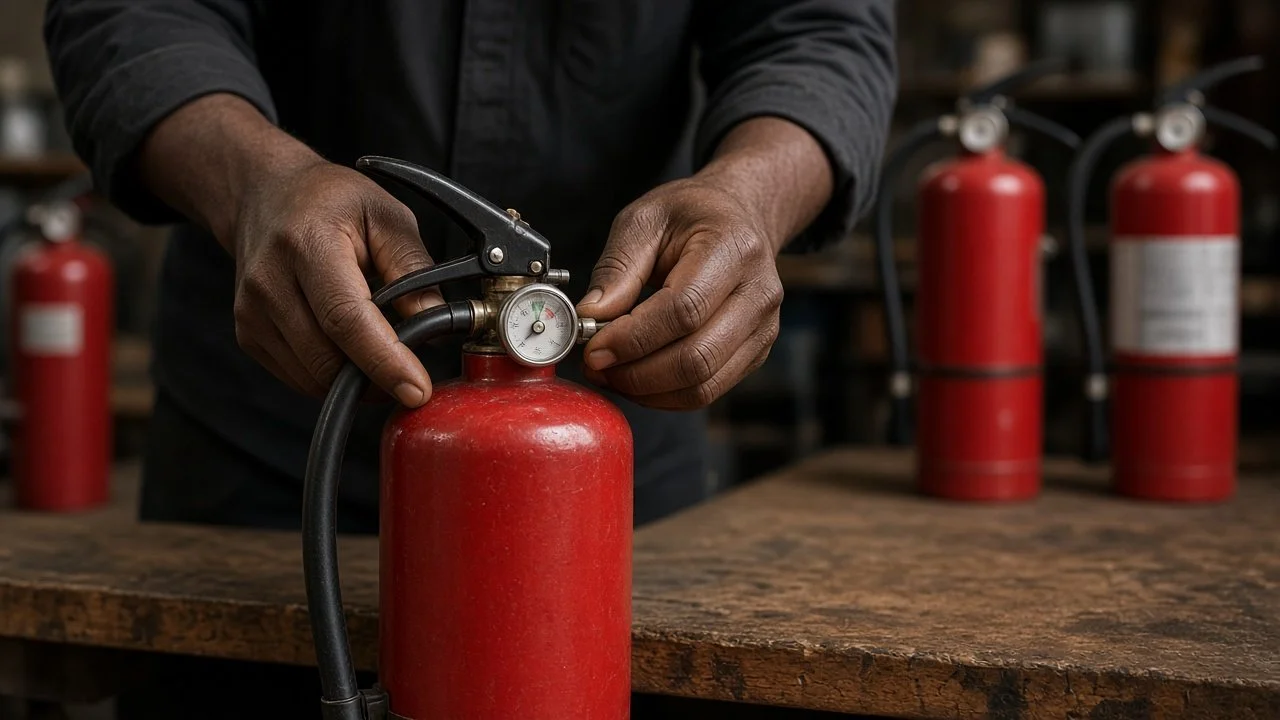

Fire extinguisher servicing on ships is easy to fold into a general LSA and fire-equipment round, and just as easy to under-specify. Portable extinguishers are inspected by the crew at short intervals, professionally serviced on a regular cycle, and periodically emptied, examined and hydrostatically tested. Those are not the same jobs, and a short port stay is a poor moment to discover that a five-year or ten-year test, or a whole bank of due extinguishers, has been left as an annual wipe-down.
This article is a practical briefing for masters, safety officers and superintendents. It explains the usual difference between crew checks, annual servicing and hydrostatic testing, and what to send before a call in The Bahamas or South Florida. Exact intervals and test pressures should be taken from the maker, the flag, class and the ship's approved maintenance plan. They are not restated here as if they were the same for every type of extinguisher.
Fire extinguisher servicing ships rely on more than a crew check
SOLAS requires fire-fighting appliances to be kept in working order and maintained under a controlled system. IMO has also published guidance on portable extinguishers and on the maintenance of fire-fighting systems, which flag states and companies commonly use as a reference. The ship's planned-maintenance system should say, for each type of extinguisher on board, what the crew does, what a service station does, and when a cylinder must be hydrostatically tested.
In outline, the pattern is usually this:
- Crew inspections, often weekly or monthly, looking at stowage, access, pressure gauges or weight, hoses, pins and obvious damage, and recording the result.
- Periodic professional servicing, commonly annual, carried out by a competent service provider, which goes further than a visual check and is recorded so that a certificate or a service tag can be produced.
- Hydrostatic testing and internal examination, at longer intervals set by the maker, the flag and class, and often different for water, foam, powder and carbon dioxide cylinders.
A carbon dioxide extinguisher and a dry-powder extinguisher are not automatically on the same test calendar. Do not assume a single "every five years" rule for the whole ship. Read the list.
Portable extinguishers are also only one part of the fire inventory. Hoses, hydrants, fixed systems and breathing apparatus follow their own maintenance schedules. If those dates fall in the same port window, it is worth saying so early, rather than discovering a second job once the extinguishers are already ashore.
What to put on the servicing list
Before you request attendance, walk the ship, or have the safety officer walk it, and build a list rather than a guess.
- Identify each extinguisher by location, type, size and any serial or bottle number.
- Note the last professional service date and the last hydrostatic test date, from the tag, the collar or the ship's file.
- Group those that can be landed or serviced together, and those that must remain in place until a replacement is in the same compartment.
- Flag any cylinder whose hydrostatic test falls due this year, because that work takes longer than a standard annual service.
- Include spare extinguishers, not only those in the accommodation and on deck.
If the same call also needs work on a fixed fire system, breathing apparatus or other fire equipment, say so in the first message. LSE Servicing & Support at Russmill Maritime Services covers extinguishers and related fire-fighting equipment, including hydrostatic testing, for vessels calling The Bahamas and South Florida. A combined brief is easier than two separate visits to the same gangway.
What to send before a short stay
When you request fire extinguisher servicing, include the vessel name, ETA, port or berth, the list and due dates, and whether time alongside is short. If some spaces cannot be taken out of service, say so. It may be possible to work with spare or exchanged units so that a compartment is not left unprotected.
Send the list through the LSE/FFE contact form or to ops@russmillmaritime.com. Quote requests are answered within 12 to 24 hours. For urgent vessel needs, call +1 242 821 7780. Office hours are Monday to Friday, 9:00 am to 5:30 pm. The FAQs set out what to include in a servicing enquiry.
On completion, check the service record against the list before the ship sails: every extinguisher identified, the work done, the next due date, and a copy for the master and the office. Extinguishers that have been emptied for test should not be returned to a station empty.
Frequently asked questions
Is the crew's monthly check enough to satisfy the annual service? Usually not. Crew inspections are essential and should be recorded, but periodic professional servicing is a different job. Follow the ship's maintenance plan and the flag or class requirement.
How often must an extinguisher be hydrostatically tested? The interval depends on the type of extinguisher and on the maker, flag and class rules that apply to the ship. Confirm it from those sources. Do not apply a single remembered interval to every cylinder on board.
Can the work be done if the vessel is only in port for a short time? Often the annual servicing can, if the list is sent early and any need for exchange or spare units is clear. Hydrostatic testing may need more time. Raise that in the first enquiry, not after arrival.
Send the due-date list now
If you already know which extinguishers fall due in the next quarter, send the list through the LSE/FFE contact form or email ops@russmillmaritime.com. We will respond within 12 to 24 hours with a plan that fits the call.