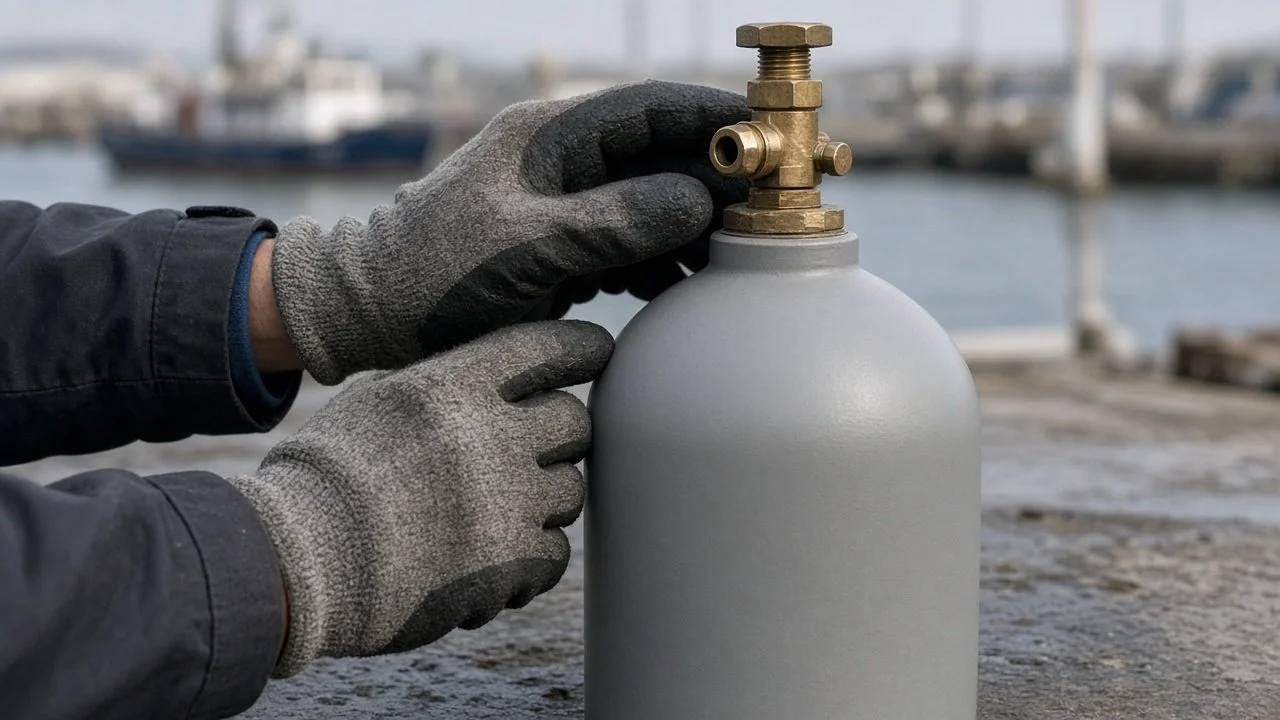

Marine refrigerant supply is one of the easier items to leave until the last afternoon, and one of the easier ones to get wrong. A provisions plant, a cargo system or an air-conditioning unit that is short of gas will not be put right by a crate that arrives after the pilot is booked, or by a cylinder of the wrong type. Industrial gases needed for onboard work can delay a departure in the same way if the type, the quantity and the cylinder arrangement are not clear from the first message.
This article is a practical guide for chief engineers, superintendents and purchasing officers ordering refrigerant or industrial gases for a call in The Bahamas or South Florida. It explains what to specify, which MARPOL Annex VI rules already apply to ozone-depleting substances, and how to time delivery. It does not invent stock lists, prices, or a promise that a particular gas is on the shelf.
Planning marine refrigerant supply before the ship is alongside
The first useful message names the substance and the system, not a general request for “gas.” Send:
- The vessel name, ETA, port or berth, and a 24-hour technical contact
- The exact refrigerant or industrial-gas type, and the quantity required, preferably by mass for refrigerants and by cylinder size and number for industrial gases
- Which system the refrigerant is for, and whether the need is a recharge of an existing installation or a new installation
- Whether empty cylinders are to be landed, exchanged, or remain on board
- Any recovery, reception or documentation the ship or the flag will need
- How short the window alongside is
Ship Supply at Russmill Maritime Services includes refrigerant and industrial gases. Send the list through the ship supply contact form, or with a wider enquiry through request a quote. Quote requests are answered within 12 to 24 hours. For urgent vessel needs, call +1 242 821 7780. Office hours are Monday to Friday, 9:00 am to 5:30 pm. Stock is not assumed. The earlier the specification arrives, the earlier it is possible to say what can be delivered in the time available.
A part number or a trade name copied from an old invoice can be out of date. If the ship's records and the name-plate on the plant do not agree, say so, and send a photograph of the name-plate if you have one, provided it is needed for identification and the enquiry is otherwise complete.
Rules that already apply
Regulation 12 of MARPOL Annex VI already controls ozone-depleting substances on ships that fall under those provisions. Deliberate emissions of those substances are prohibited, including emissions in the course of maintaining, servicing, repairing or disposing of systems, except for minimal releases associated with recapture or recycling. When ozone-depleting substances or equipment containing them are removed from a ship, they are to be delivered to appropriate reception facilities.
Installations containing ozone-depleting substances other than hydrochlorofluorocarbons have, under the current Regulation 12 text, been prohibited on ships constructed on or after 19 May 2005, and as new installations on existing ships from that date. Installations containing hydrochlorofluorocarbons have been prohibited on ships constructed on or after 1 January 2020, and as new installations on existing ships from that date. Existing systems may continue in service and may be recharged as necessary. Permanently sealed equipment without charging connections or removable components is outside the scope of the regulation.
Ships that are required to do so must keep a list of equipment containing ozone-depleting substances, and those with rechargeable systems containing those substances must keep an ozone-depleting substances record book, with entries in kilograms for supply, recharge, repair, and discharge ashore or to the atmosphere. Confirm the current text, and any flag instructions, against the ship's IAPP documentation.
A refrigerant that is not an ozone-depleting substance is not thereby free of all other rules. Flag, company, or port requirements, and safe handling of cylinders, still have to be checked. This article does not set out a list of approved substitutes, because that list would be incomplete and would date quickly. Name the substance the plant is designed for, and ask whether it can be supplied for that use.
Industrial gases should be identified with the same care: the type, the intended use, and whether the ship needs a full cylinder, an exchange, or a particular fitting. Do not assume that a cylinder left over from another job is the right one.
After delivery
Check the type, the quantity and the cylinder numbers against the order before the ship sails. Land empty or recovered cylinders as agreed, and complete any record-book entries while the facts are still in front of you. If a recovered ozone-depleting substance is being landed, it should go to an appropriate reception arrangement, not into a general waste stream.
Frequently asked questions
Can you supply any refrigerant the ship used to buy? Only if it can legally be supplied for that use, and if it can be obtained in time. A type that may still be used to recharge an existing system is not automatically available as a new installation. Send the exact type and say whether the plant is existing or new.
Do we need to land recovered gas? If ozone-depleting substances are removed and are not to be reused on board, Regulation 12 requires them to be delivered to appropriate reception facilities. Raise that need in the first message.
What if we only know the trade name, not the type? Send the trade name, the system, and a name-plate photograph if you have one. A correct type identification still has to be confirmed before the gas is delivered.
Send the specification with the first enquiry
If you already know which refrigerants or industrial gases are needed for the next Bahamas or South Florida call, send the list through the ship supply contact form or email ops@russmillmaritime.com. We will respond within 12 to 24 hours with what can be arranged in the time alongside.