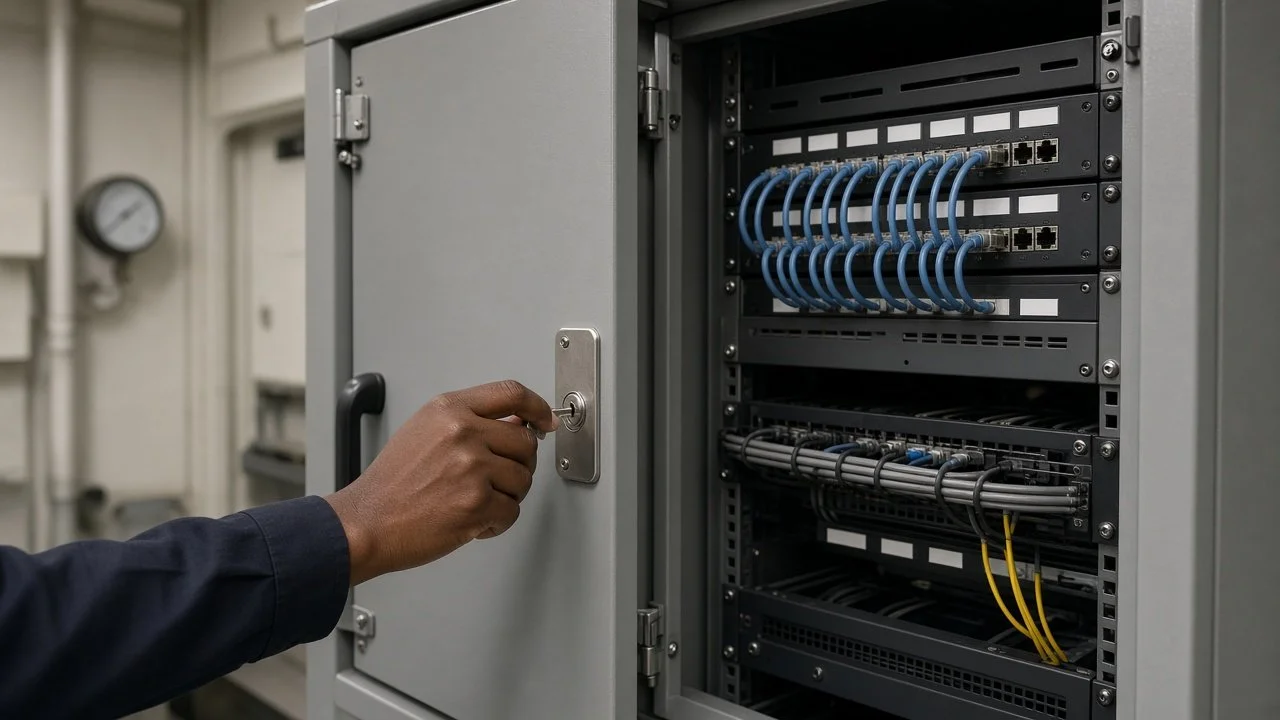

Maritime cyber security is no longer an optional extra beside the ship's safety management system. Since 1 January 2021, shipping companies have been expected to address cyber risks in the safety management systems required by the ISM Code, following IMO resolution MSC.428(98). The detail of how to do that is not all in the resolution. It sits in the company's procedures, in current IMO guidance such as MSC-FAL.1/Circ.3, and in industry guidance such as the BIMCO guidelines, which should be read in the edition now in force.
This article is a practical briefing for operators, designated persons and masters. It is not a complete cyber programme, and it does not cite incident statistics or claim that any particular system is safe or unsafe. It explains what the standing duty looks like in ordinary shipboard terms, and what is worth checking before a port call.
What maritime cyber security looks like in practice
A useful starting point is an inventory: which systems on the ship, and in the office that supports it, could affect safe operation or the confidentiality of operational data if they failed or were misused. That list often includes navigation and communications equipment, engine-room and cargo control systems, administrative networks, and the laptops and removable media that travel with the crew. The inventory does not have to be a long technical essay. It does have to be accurate, and it has to be kept current when equipment is added or replaced.
From that inventory, the SMS can set proportionate controls. In most companies those controls include:
- Access. Who may log in to which system, with unique accounts where practicable, and with privileges limited to the work the person is required to do.
- Remote and vendor access. A maker's technician or a superintendent who connects from ashore should do so only under a controlled arrangement, for a defined purpose, and the access should be closed when the work is finished.
- Removable media and personal devices. A policy that is actually followed matters more than a long list of banned items that nobody can apply on board.
- Network separation, where it is practicable. Operational technology and ordinary office or crew networks should not be treated as if they were the same environment.
- Backups and recovery. Configuration and essential data should be recoverable if a system fails or has to be taken offline.
- Training and reporting. The crew should know what to do with a suspicious message, a lost device, or a system that is not behaving as it should, and they should have a clear person to tell.
None of this replaces the maker's instructions for a particular piece of equipment, or the flag's own expectations. It is the company's job to bring those sources into the SMS and to audit whether the ship is following them.
Port calls, vendors and the shore interface
A port call is a moment when more people and more devices come close to the ship. Agents, technicians, surveyors and cargo interests may need to exchange documents, send updates, or connect equipment. That does not make every visitor a cyber risk, but it is a reason to apply the same access rules the company already has, rather than setting them aside because the stay is short.
Practical steps that do not require a specialist team include agreeing in advance how documents will be sent, avoiding ad hoc USB transfers where another method is available, and making sure that any technician who needs a connection is working under the ship's permit and the company's remote-access rules. If a repair or a survey will require a laptop to be connected to a ship's system, that should be part of the job plan, not a surprise at the cabinet.
Port Agency & Logistics still needs the usual pre-arrival information for a Bahamas or South Florida call. The FAQs set out what to send. Cyber controls should sit beside that planning, not instead of it. A clear, timely arrival message remains the right way to arrange a call.
If an incident does occur — a system unavailable, a suspected intrusion, or a ransomware demand — the first duty is still the safe navigation and operation of the ship. Follow the company's incident procedure, protect the crew and the vessel, preserve what evidence you can without interfering with safety, and inform the office and, where required, the flag or other authorities. Do not improvise a technical fix that takes a navigation or propulsion system out of a known state.
Frequently asked questions
Does MSC.428(98) mean every ship needs a separate cyber manual? Not necessarily a separate manual. The resolution expects cyber risk to be addressed in the SMS. Some companies write a dedicated procedure; others fold the controls into existing ISM documentation. The test is whether the arrangements are implemented and audited, not what the file is called.
Which industry guidance should we follow? Start with the current IMO guidance, including MSC-FAL.1/Circ.3, and with recognised industry guidance such as the BIMCO guidelines in the edition now in force. Confirm any flag circulars that apply to the ship.
Are older ships outside this duty? The ISM duty applies to companies and ships that fall under the Code. Age of the ship is not a reason to ignore cyber risk in the SMS. The controls should still be proportionate to the systems actually fitted.
A short closing note
This is an industry briefing, not a cyber audit and not a claim about any particular vessel. Russmill Maritime Services Limited is a ship supplier, service provider and port agent in The Bahamas and South Florida. For questions about an upcoming call, email ops@russmillmaritime.com or call +1 242 821 7780.