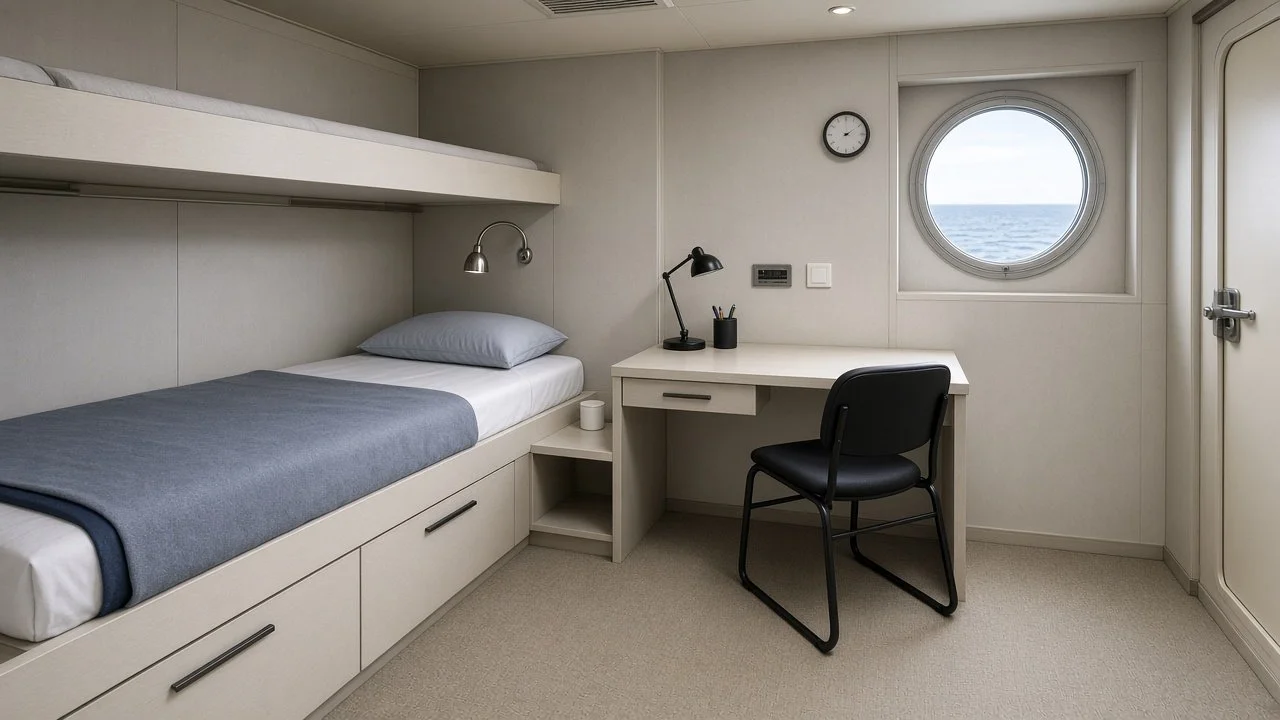


MLC 2006 seafarer rights are often reduced, in hurried conversation, to a single pair of rest figures. The Maritime Labour Convention, 2006, which entered into force on 20 August 2013, is broader than that. It sets minimum standards for, among other things, conditions of employment, hours of work or rest, accommodation, food, health protection, medical care, and access to shore-based welfare, for seafarers on ships that fall within its scope. This article is a plain-English briefing for masters, operators and crew. It is not legal advice, not a statement of any flag's current implementation, and not a list of later amendments treated as automatically in force.
The photographs are present-day illustrations of life on board. The cabin photograph should not be read as evidence that any particular cabin meets a Convention dimension.
MLC 2006 seafarer rights on hours of work or rest
On hours, the Convention does not give only one option. Under Regulation 2.3 and Standard A2.3, the Member fixes either a maximum hours of work or a minimum hours of rest.
- If the basis is maximum hours of work, those hours are not more than 14 hours in any 24-hour period, and 72 hours in any seven-day period.
- If the basis is minimum hours of rest, those hours are not less than ten hours in any 24-hour period, and 77 hours in any seven-day period.
The ship should confirm which basis the flag has applied, and should record hours against that basis, in the form the flag and the company require. It is a common mistake to treat 10 hours and 77 hours of rest as the only possible rule. Hours of rest may be divided into no more than two periods, one of which must be at least six hours in length, and the interval between consecutive periods of rest must not exceed 14 hours. Short breaks are not hours of rest.
Muster, drills and emergency work have their own provisions in the Standard, which should be read in the current official text rather than summarised here as a shortcut. The point for daily life is that rest is planned, recorded and protected, not hoped for after the work is finished. Records of hours of work or rest should be kept in the form the flag and the company require, in a language or languages the seafarer can understand, and should be available for inspection. A seafarer should be able to have a copy of the record that concerns that seafarer. If the record and the watch bill do not match, the mismatch should be resolved at the time, not left for a later inspection to find.
Living conditions, welfare and a port call
Accommodation, food and drinking water, medical care, and access to shore-based welfare facilities, so far as they apply to the ship, are part of the same Convention, not optional extras. The detail should be taken from the current official text and from the flag's implementation, including any later amendments the flag has given effect to. This article does not invent a list of those amendments, and it does not treat a later change as in force for every ship. Food and drinking water should be suitable, and provided in a way the Convention and the flag require; a long stay or a delayed departure is not a reason to let the standard slip. Medical care on board, and access to care ashore when it is needed, should be arranged under the same framework. If a seafarer needs medical attention in port, that should be said early so that the agent and the company can help with the arrangements, without treating this article as a medical procedure.
On a port call, hours of work or rest still apply. Cargo, stores, surveys and a crew change can fill a day if they are not planned. If people are joining or leaving, or if medical or welfare arrangements are needed ashore, tell the agent early. Port Agency & Logistics can help with crew changes and related husbandry; the FAQs set out the usual information to send. The Convention's standards are the company's and the master's responsibility; the agent can support the arrangements, not waive the record.
Seafarers should also be able to see how a complaint can be raised, under the ship's procedures and the Convention, without being punished for using that process. That is a rights point, not a suggestion that an article can hear a complaint. Employment agreements, wages, leave, and repatriation also sit in the Convention; the current official text and the flag are the sources for the detail, not a short trade briefing. A crew change planned in The Bahamas or South Florida should be arranged so that joining and leaving still respect hours of rest and the documents the people concerned will need.
Frequently asked questions
Is 10 hours of rest in 24 hours the only MLC rule on working time? No. The Member chooses either a maximum hours of work or a minimum hours of rest, within the limits in Standard A2.3. Confirm which basis the flag has applied.
Do later MLC amendments automatically apply to every ship? Not automatically in the way an article can list. Confirm from the current official ILO text and from the flag what has entered into force and what the ship must apply.
Can a short port call ignore hours of rest? No. The stay may be short; the Standard still applies. Plan cargo, stores and crew movements so that rest can still be taken and recorded.
A short closing note
This is an industry briefing, not legal advice and not a statement of any flag's current implementation. Russmill Maritime Services Limited is a ship supplier, service provider and port agent in The Bahamas and South Florida. For questions about an upcoming call, including a crew change, email ops@russmillmaritime.com or call +1 242 821 7780.