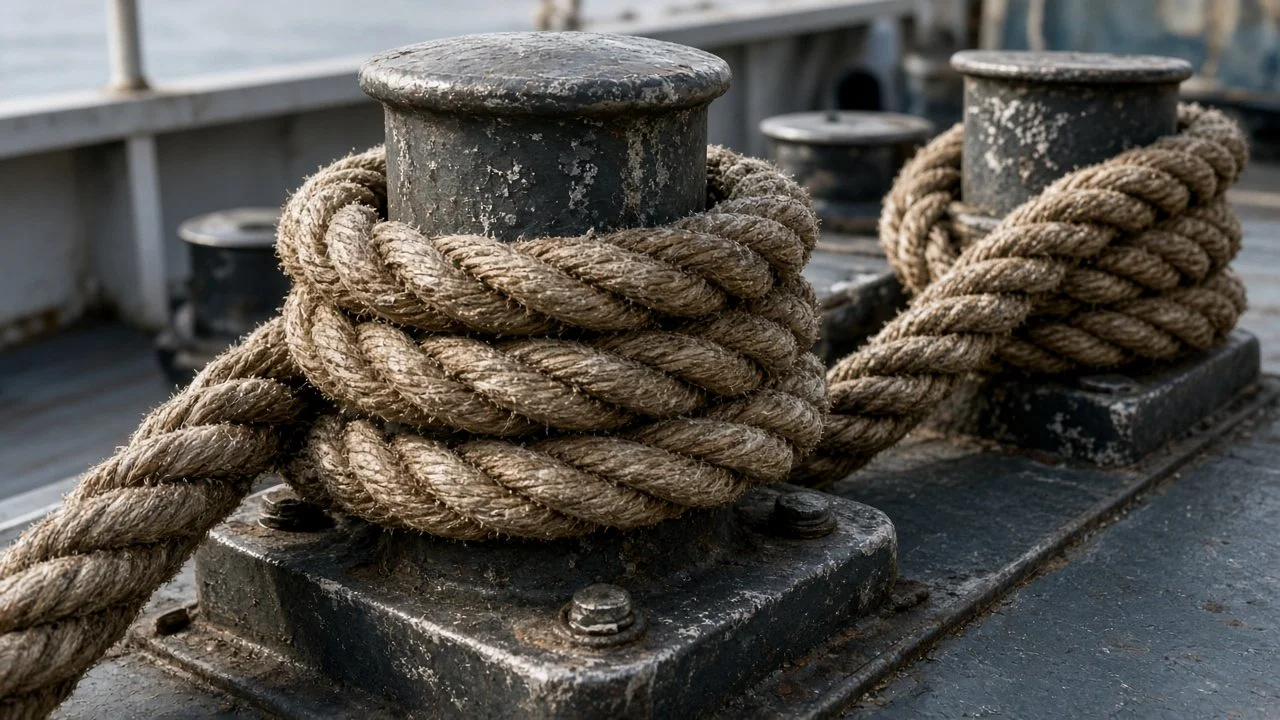

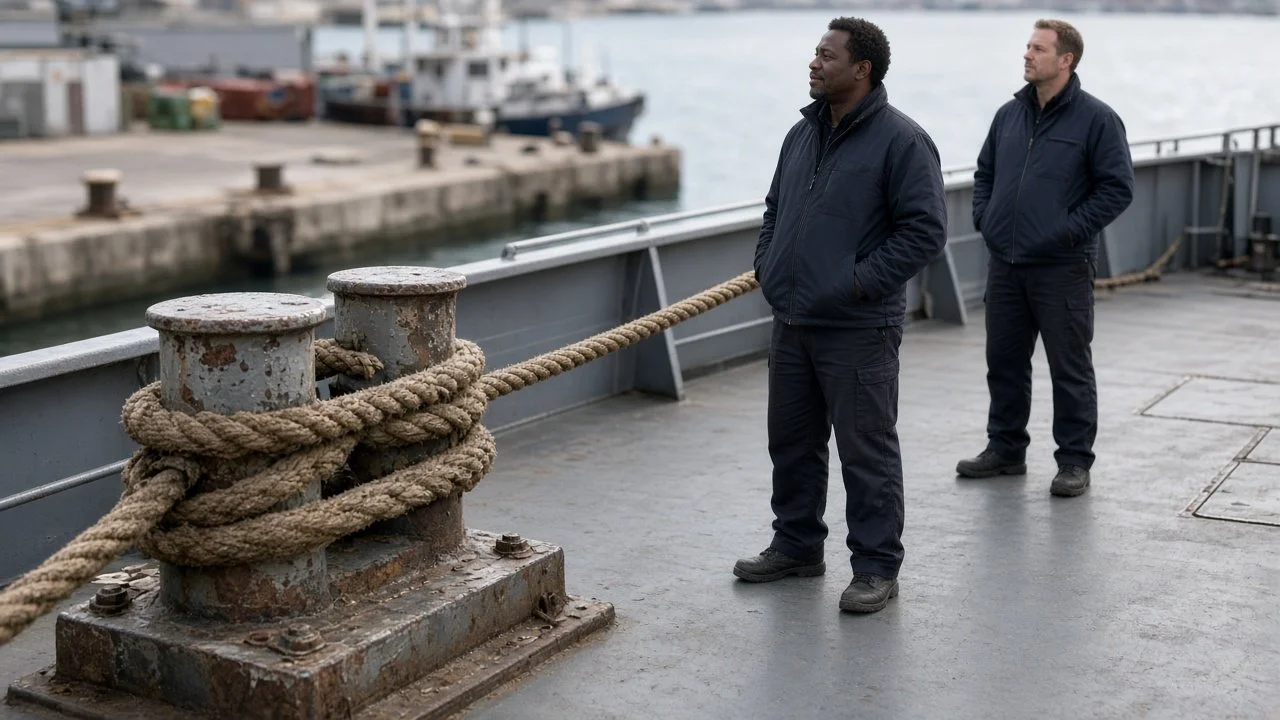
Mooring safety snap-back zones are not a painted box that looks the same on every ship. A mooring line under load stores energy. If it fails, or if a joining shackle or a tail fails, that energy can be released suddenly, and people standing in the path can be killed or seriously hurt. The path is not always a neat triangle behind the bitt. It depends on the layout, the lead, the type of line, and how the ship is made fast. A diagram from another vessel, or from an old poster, should not be treated as a survey of this deck.
This article is a practical briefing for masters, officers and deck crews. It is not a mooring manual, not a design standard, and not a substitute for the company's procedures or for current industry guidance such as the OCIMF mooring equipment guidelines, in the edition now in force. It does not invent snap-back angles, load figures, or a layout for any particular berth in The Bahamas or South Florida.
What mooring safety snap-back zones require in practice
The first habit is to treat every loaded line as a hazard, not only the one that looks worn. Before stations, the crew should already know where they may stand, where they may not, and who is in charge of the operation. People should not stand in the bight of a line, over a line, or in the likely path if it parts. A person who is also handling a heaving line, a radio and a postcard from the agent at the same time is not keeping a proper watch on the ropes.
Lines, tails, shackles, roller leads and bitts should be in a condition the company's inspection routine requires, and fit for the job they are being asked to do. Mixed or inappropriate tails, damaged splices, and equipment used beyond the purpose it was designed for, are recurring problems. Current industry guidance should be read for the ship as she is fitted, not remembered from a previous vessel. Winch settings, brake condition and the way a line is paid out or heaved all belong in the same preparation. A line that has been standing in sunlight, chemicals or a sharp lead should be inspected with that history in mind, not only with a date in a log. Personal protective equipment is part of the same habit; it is not a substitute for standing well out of the path.
Communication with the shore, the tug if any, and the bridge has to be agreed before the first line goes ashore. A misunderstood instruction is as dangerous as a bad rope. The same is true of a rushed departure, or of a change of berth in the middle of the night, when people are tired and the deck is wet. Restricted visibility, rain and a short stay do not relax the need to stand clear.
Ports, equipment and the ship's own plan
A call in The Bahamas or South Florida does not have a special, unofficial snap-back rule. The ship's procedures, the terminal's instructions, and the condition of the ship's own equipment still decide how the operation should be run. If a terminal has its own mooring requirements, they should be taken from the terminal and from the agent, not from a remembered call at another berth. The FAQs set out the usual pre-arrival information; a particular mooring arrangement, if already known, is worth mentioning.
Equipment that is damaged, or that is due for replacement, should be dealt with as a technical and a safety item, not left until the next docking. Marine Technical Services may be relevant when steelwork, roller leads or fittings need repair in port; that work is not a substitute for the mooring plan itself.
After a mooring or an unmooring, a short review of what did not go as planned — a line that jumped, a person who was in the wrong place, a brake that did not hold as expected — belongs in the ship's reporting system while the facts are still clear. A near miss that is not reported will be repeated.
Frequently asked questions
Is there one snap-back zone diagram that fits every ship? No. The likely path depends on the layout and the lead. The company's guidance, and current industry guidance for the equipment fitted, should be applied to this deck, not copied from another ship without thought.
Do synthetic lines and wire behave in the same way if they fail? They do not. Each type has its own hazards. Follow the guidance that applies to the lines actually in use, and do not assume that experience with one material is enough for another.
Who is responsible for the people on the quay? Shore staff are not under the ship's command in the same way as the crew, but the operation is still a shared risk. Communication with the terminal, and a clear understanding of when lines will be heaved or slackened, is part of a safe mooring.
A short closing note
This is an industry briefing, not a mooring procedure and not a design assessment of any particular ship. Russmill Maritime Services Limited is a ship supplier, service provider and port agent in The Bahamas and South Florida. For questions about an upcoming call, email ops@russmillmaritime.com or call +1 242 821 7780.